Noclip : Backrooms Multiplayer
- 3.9
- Rating
- 10.00M
- Installs
- Free
- Price
 Analysis by App-foxy
Noclip: Backrooms Multiplayer caught my attention because it turns a very simple horror idea into a social action game: you enter an unsettling backrooms environment, try to survive its dangers, and work with friends to find a way out. My first impression was that the setting does most of the talking. The empty rooms, repetitive architecture, and lack of a familiar destination create tension before the game needs to explain much.
It is a free game from superfps - fzco, aimed at Teen players, and it has become a substantial download on mobile, with over ten million installs. That popularity makes sense to me: the concept is easy to understand, the multiplayer angle gives it immediate appeal, and the strange setting is recognizable enough to make a quick session feel different from a standard shooter or survival game.
I would not approach it expecting a deep campaign with carefully developed characters. I see it more as a tense group experience, where the fun comes from uncertainty, communication, and the reactions of the people playing with you. When the mood works, even moving through an apparently ordinary corridor can feel like a decision. When the mood loses its grip, the repeated spaces can feel more like a limitation than a mystery.
You May Also Like

 Blood Strike: 2.5 Anniversary
Blood Strike’s Loadouts Turn Every Drop Into a Tactical Gamble
A close look at Blood Strike’s custom loadouts: how fast access to signature weapons reshapes its battle royale rhythm, rewards preparation, and narrows the gap between fights.

 Pandora - Music & Podcasts
Pandora’s Music Is Easy to Start, but Harder to Recover
Pandora’s strength is its low-effort path from a seed to a station. Its weak spot is how much confidence it asks you to place in connection, setup, and quiet recovery.

 8 Ball Pool
 Is Built on Rivalries, Rematches, and Routine
A close look at the rivalries, rematches, shared routines, and unanswered safety questions that turn a quick pool match into a persistent mobile community.

 Samsung Music
’s Quiet Strength Is Playing What You Already Own
Its reach comes less from spectacle than from dependable access to a personal library. That simplicity is both the app’s strongest retention engine and its ceiling.

 AccuWeather: Weather Radar
AccuWeather Review: A Quick, Clear Forecast for Everyday Decisions
For everyday plans, the best forecast is the one you can understand quickly. AccuWeather makes rain timing, radar, and local conditions easy to act on, with a few trade-offs.

 Hill Climb Racing
Why Hill Climb Racing Still Turns Crashes Into One More Run
A tiny car, a bumpy hill and one more upgrade: Hill Climb Racing keeps resurfacing because its simple chaos makes every near-miss feel personal.
More From Our News Desk



How the first few sessions feel
The opening experience is built around disorientation. Instead of giving me a clearly marked battlefield or a familiar objective loop, the game places emphasis on being somewhere that feels wrong. The backrooms concept works particularly well on a phone because the screen keeps the environment close to my attention. I am not casually looking across a huge landscape; I am watching corners, corridors, and nearby spaces for anything that might change the situation.
The multiplayer premise changes the emotional tone immediately. Playing alone would make the setting more oppressive, but playing with friends introduces a second kind of tension: staying together may be safer, while separating can make exploration more efficient or more exciting. That choice gives ordinary movement some purpose. A short conversation about which direction to take can become more memorable than a straightforward combat encounter.
In an everyday scenario, I can imagine opening the game with a small group after dinner, expecting a quick round. One player takes the lead, another keeps checking behind the group, and someone else gets distracted by a side route. The session becomes entertaining not because every moment is packed with action, but because everyone is trying to decide whether the next hallway is worth the risk. That social uncertainty is one of the strongest reasons to try it.
The game is easier to appreciate when I accept that it is not trying to be a conventional action title. If I want constant shooting, clearly marked objectives, or rapid progression, the first session may feel too quiet and indirect. If I enjoy horror built from anticipation and cooperative confusion, the slower start has a better chance of working.
The current version is 2.2, and the game supports devices running Android 7.1 or later. That makes it accessible across a broad range of Android phones, although the practical experience can still depend on the device, screen size, and control comfort. A smaller display may make the environment feel more intimate, but it can also make movement and observation less comfortable during a tense chase.
A world built from repetition and doubt
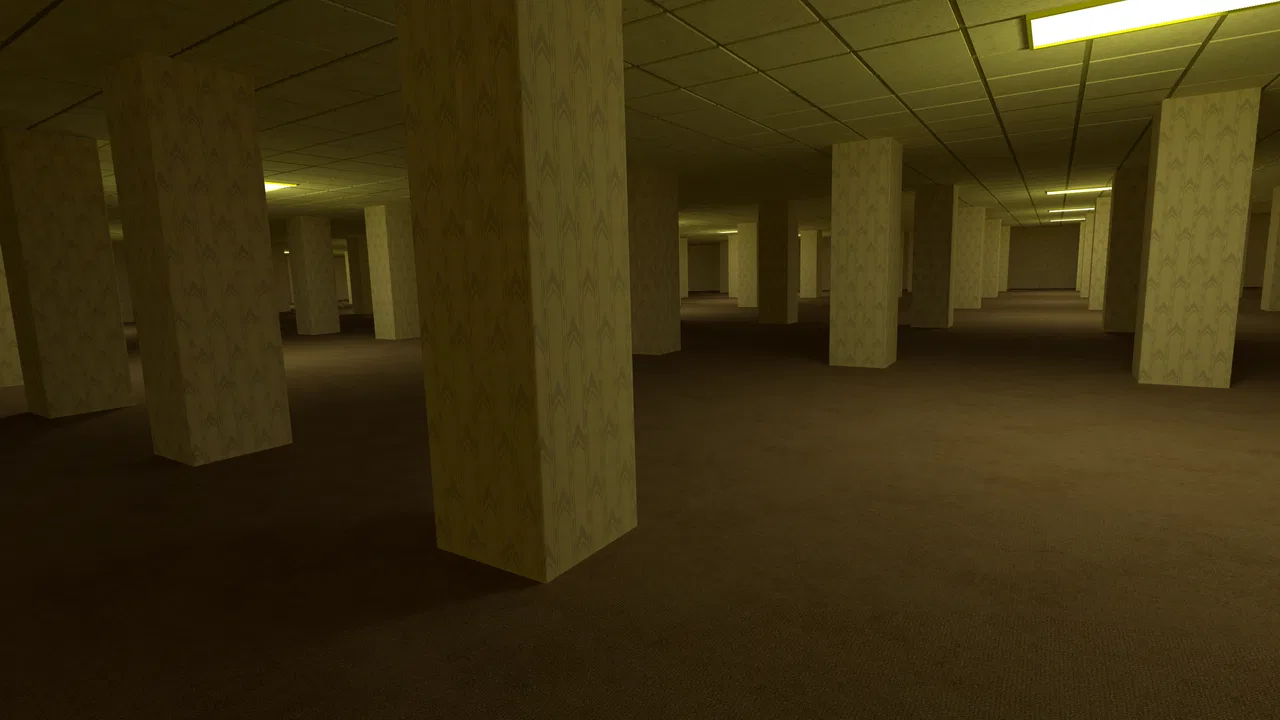
The art direction is deliberately restrained. The backrooms setting is effective because it does not need a crowded visual design to communicate danger. Repeated walls, similar passages, and spaces that lack a clear purpose create a visual language of uncertainty. I cannot rely on landmarks in the same way I would in a normal action game, so I pay more attention to small differences in the environment.
That repetition is both the game’s strongest atmospheric tool and its most obvious trade-off. It makes navigation feel confusing, which supports the premise, but it can also make progress difficult to judge. In a conventional map, reaching a new room usually feels like advancement. Here, reaching another similar room may feel like going in circles. I think that is intentional, but intention does not remove the possibility of frustration.
The setting also benefits from restraint because it leaves space for the player’s imagination. A brightly explained monster or an overloaded interface would weaken the strange emptiness. The world feels more coherent when I am allowed to wonder whether a sound, movement, or visual detail matters. That uncertainty is more valuable than constant visual spectacle.
One practical tip is to treat environmental memory as part of the challenge rather than relying only on instinct. When playing with friends, I find it useful to describe spaces by visible traits instead of vague directions: a long straight passage, a room with a distinctive opening, or a turn that looks different from the surrounding corridors. Even without a conventional navigation routine, clear verbal descriptions can reduce pointless wandering.
This is also where the multiplayer design and art direction support each other. A confusing environment gives the group something to discuss. Players naturally compare what they saw, where they came from, and whether a route looks familiar. The world is not simply a backdrop for action; it creates the conversation that makes cooperative play worthwhile.
Why sound matters more than visual detail
Sound carries much of the emotional weight. In a setting where rooms can look alike, audio helps me judge whether the space feels calm, exposed, or threatening. A quiet stretch does not feel empty in a neutral way. It feels like a pause during which I am waiting for the game to reveal whether I made a safe choice.
The pacing works best when the game allows tension to build instead of immediately spending it. Sudden danger has more impact after a period of uncertainty. I become more alert when nothing obvious is happening, because the silence encourages me to listen rather than simply react to a visible target. That approach makes the game’s mood feel more consistent than a design that alternates nonstop between loud scares and routine movement.
Playing with friends creates an interesting contrast. Voice communication can reduce fear because conversation makes the group feel organized, but it can also make a surprise more memorable. A player who suddenly stops talking, calls for help, or gives an uncertain direction can change the mood faster than a scripted explanation. The social layer becomes part of the soundscape.
I recommend using headphones when possible, especially if the room around me is quiet. The game’s atmosphere depends on noticing changes in the audio environment, and background noise can flatten those differences. Headphones will not transform the mechanics, but they can make the pacing easier to read and the setting more convincing.
There is a trade-off here for players who prefer relaxed mobile gaming. The same audio focus that helps the horror mood can make a casual session feel more demanding. This is not something I would choose as background entertainment while multitasking. It asks me to pay attention, and the experience loses some of its effect when I repeatedly look away from the screen.
Where the mechanics support the mood
The central mechanical fit is straightforward: exploration becomes tense because the environment is uncertain, and multiplayer turns navigation into a shared problem. That is a good match for the backrooms idea. The mechanics do not need to compete with the setting; they give me reasons to move through it, make choices, and communicate.
The cooperative structure is most enjoyable when each player contributes awareness rather than simply following one leader. I prefer a group where people call out what they notice, remember previous turns, and decide together when to continue or regroup. This makes the session feel more like a team attempt than four people moving through the same space independently.
A useful habit is to agree on a simple communication style before the atmosphere becomes stressful. Short callouts such as “stay together,” “check behind,” or “return to the last room” are more useful than long explanations during a tense moment. This is a small adjustment, but it prevents the multiplayer experience from becoming noisy and directionless.
Another trade-off is that the game’s appeal depends heavily on the group. With friends who enjoy uncertainty, the lack of certainty becomes the point. With players who dislike getting lost, the same design can feel repetitive. A cooperative horror game cannot fully solve differences in patience: one person may want to investigate every route while another wants to move quickly toward an exit.
That makes the game less suitable for players searching for a polished competitive action experience. The category may be action, but the most memorable moments come from suspense, exploration, and group decisions rather than from mastering a large combat system. Someone who normally chooses fast arena games may find the pace too restrained, while a horror fan may appreciate the breathing room.
Compared with a usual single-player horror game, this title gives up some control over pacing in exchange for shared reactions. A solo game can carefully position every scare and guide the player through a precise sequence. Here, friends can interrupt the intended mood with jokes, arguments, or accidental mistakes. I see that as a feature when the goal is a social night, but it means the atmosphere is less controlled.
Compared with a typical mobile action game, it also asks for more patience. There is less immediate satisfaction from collecting rewards or clearing obvious objectives. The payoff is the experience of navigating a strange place together. That is a narrower appeal, but it is also what gives the game an identity beyond being another action title.
Who will get the most from it
I think the best audience is a group of friends that enjoys cooperative horror without needing a complex setup. The game is easy to explain: enter the backrooms, stay alert, and try to escape together. That makes it approachable for players who may not regularly play horror games but want something more unusual than a standard multiplayer shooter.
It is also a good fit for short shared sessions. The concept creates conversation quickly, so a group does not need to invest a long time before deciding whether the experience works for them. The free price removes a financial barrier, which is helpful when introducing the game to friends who are unsure about the genre.
I would be more cautious about recommending it to someone who plays primarily alone and wants a detailed narrative. The setting creates questions, but the main pleasure is navigating and surviving the situation, not following a character-driven story. Likewise, players who need constant progression, varied objectives, or a highly precise map may become impatient with the deliberately repetitive spaces.
The Teen content rating is worth keeping in mind for families. The game’s appeal comes from suspense and unsettling situations, so it is not aimed at very young children even though the basic concept is easy to understand. I would also consider the social setting: playing with trusted friends is a better match than joining a group where communication may be unpleasant or distracting.
Small choices that improve a session
I get more from the game when I decide in advance what kind of session I want. If the group wants atmosphere, we keep conversation focused and avoid turning every quiet moment into a joke. If the group wants a lighter experience, we accept that the horror will be interrupted and treat the game as cooperative chaos. Both approaches can work, but expecting one while playing the other leads to disappointment.
Keeping the group organized is more important than rushing. When everyone moves in a different direction, the setting’s confusion becomes unnecessary frustration. A loose formation, regular regrouping, and clear descriptions of turns make exploration easier without removing the uncertainty that gives the game its mood.
I also suggest judging progress by decisions rather than distance. In a normal action game, moving farther often feels automatically positive. Here, choosing to retreat, wait, or reunite can be the smarter move. That mindset helps me appreciate the pacing instead of treating every pause as wasted time.
Finally, I would play with a comfortable control setup and enough battery for an uninterrupted session. This sounds basic, but horror depends on concentration. A cramped grip, repeated interruptions, or a phone that becomes uncomfortable to hold can break the tension more quickly than any design weakness.
My atmosphere verdict
The strongest part of Noclip: Backrooms Multiplayer is the way its setting, sound, and cooperative uncertainty reinforce one another. The repeated architecture creates doubt, the audio gives quiet moments weight, and the multiplayer format turns navigation into a conversation. I rarely feel that the game is trying to impress me with unnecessary decoration. Its identity comes from making familiar-looking spaces feel unreliable.
Its limitations are closely connected to those strengths. The repetition that supports the backrooms mood can become tiring, and the slower rhythm will not satisfy players who want constant action. The quality of a session also depends on the group’s communication and patience. With the right friends, those weaknesses become part of the challenge; with the wrong expectations, they become the reason to stop playing.
The game has an average rating of 4.0 from around forty-five thousand ratings, alongside hundreds of written reviews, which fits my overall impression: it has a clear idea and a broad audience, but its unusual pacing will not suit everyone. I would recommend trying it with friends rather than judging it as a solo action game.
For me, this is a good choice when I want a free mobile experience built around atmosphere and shared tension instead of constant rewards. It is not the right pick for a story-heavy horror adventure or a competitive shooter, but it offers a distinct kind of cooperative unease. If the thought of getting lost with friends in an empty, unsettling maze sounds more appealing than following a familiar action formula, Noclip: Backrooms Multiplayer is worth a place in that next group session.
Released on October 31, 2022, it has continued to attract players through a simple premise that is easy to share. I would keep my expectations focused on mood, exploration, and the unpredictable reactions of a team. Seen that way, the game’s apparent emptiness becomes its main tool: it gives the players room to create the tension themselves.
FAQs for Noclip : Backrooms Multiplayer
01What is Noclip: Backrooms Multiplayer about?
Noclip: Backrooms Multiplayer is a survival horror game where players explore eerie, maze-like environments known as the Backrooms. The primary goal is to escape these unsettling spaces while avoiding lurking dangers. The game supports multiplayer mode, allowing players to team up with friends for a more immersive experience.
02Is Noclip: Backrooms Multiplayer free to play?
Noclip: Backrooms Multiplayer is available as a free-to-play game, but it may offer in-app purchases. These purchases can enhance gameplay with additional features, skins, or other items. Players should be aware of potential costs and check their device's settings to manage in-app purchase permissions.
03What devices are compatible with Noclip: Backrooms Multiplayer?
The game is compatible with both Android and iOS devices. It requires a relatively modern operating system to run smoothly. Users should ensure their device meets the minimum system requirements for optimal performance, which can be found on the app's download page.
04Does Noclip: Backrooms Multiplayer require an internet connection?
Yes, Noclip: Backrooms Multiplayer requires an internet connection, especially to access its multiplayer features. While some offline gameplay might be available, the full experience, including teaming up with friends, necessitates being online. A stable connection is recommended to avoid disruptions.
05How can players ensure a safe gaming experience in Noclip: Backrooms Multiplayer?
To ensure a safe gaming experience, players should be mindful of online interactions, especially in multiplayer mode. It's important to use privacy settings effectively and report any inappropriate behavior. Additionally, players should take regular breaks to prevent fatigue and maintain a balanced gaming routine.
Pros
- Immersive multiplayer experience.
- Variety of challenging levels.
- Regular updates with new content.
- Simple and intuitive controls.
- Engaging sound effects enhance gameplay.
Cons
- Graphics could be more detailed.
- Occasional in-game lag.
- Limited character customization.
- Ads can be intrusive at times.
- Requires stable internet connection.

Noclip : Backrooms Multiplayer
Gallery